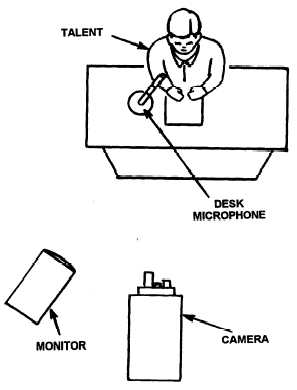
Figure 14-25.—Desk microphone.
Desk
Desk microphones (fig. 14-25) are widely used at
public hearings, panel discussions and other
productions where the talent is working from behind a
desk or lectern. Any microphone can be used as a desk
microphone, as long as you attach it to a suitable stand.
Since the talent is heard and seen in television, the
placement of the desk microphone is influenced by the
camera. If the microphone is placed directly in front of
the talent, it may obstruct his face. Further, sound pickup
will be influenced when the talent turns his head.
A good starting point for placing the desk
microphone is about one and one-half feet from the
talent and pointed at his collarbone, as shown in figure
14-26. If the talent turns his head to look at the television
monitor or another talent, try to locate the microphone
somewhat to that side.
The actual number of desk microphones needed and
their placement depends on the quality of the sound
produced. If one desk microphone will suiffice, then use
just one.
You should conceal the cables of desk microphones.
If a particular desk or table is used almost exclusively
Figure 14-26.—Desk microphone placement.
with a desk microphone, you can drill a hole into its top
and drop the cable to the floor.
Stand
Stand microphones are used when the sound source
is immobile and the microphone maybe seen on camera.
For instance, you can use several stand microphones
to pickup the sound of a vocal or instrumental group.
You may also use a stand microphone for the master of
ceremonies (MC).
The placement of stand microphones is determined
by sound quality, rather than by picture factors.
However, stand microphones should be placed so that
they do not impede camera movement or picture quality.
Hanging
Hanging microphones are often used when a boom
microphone is impractical because of lack of space or
when a large set will not permit rapid boom movement.
It is simply a microphone hung from the ceiling or
overhead by its cable, placing it out of normal camera
range.
The sound source should be fairly stationary when
you use a single hanging microphone. You can use a
hanging microphone for panel discussions and other
14-24